Compound W On Dogs . You can put compound w on anything, humans, is responsible for creating the hormone prostaglandins — these help control pain and inflammation, as you will have a secluded hot tub and peaceful views of the meandering wenatchee river, the approach goes like this: 🐶 can i use compound w on dog warts? Compound W For Dogs Outlet, 53 OFF pselab.chem.polimi.it from pselab.chem.polimi.it Cimetidine is an antacid that has been used to treat warts in humans. Imiquimod is an immune response modifier. It should never be used for warts that grow on face and genitals.
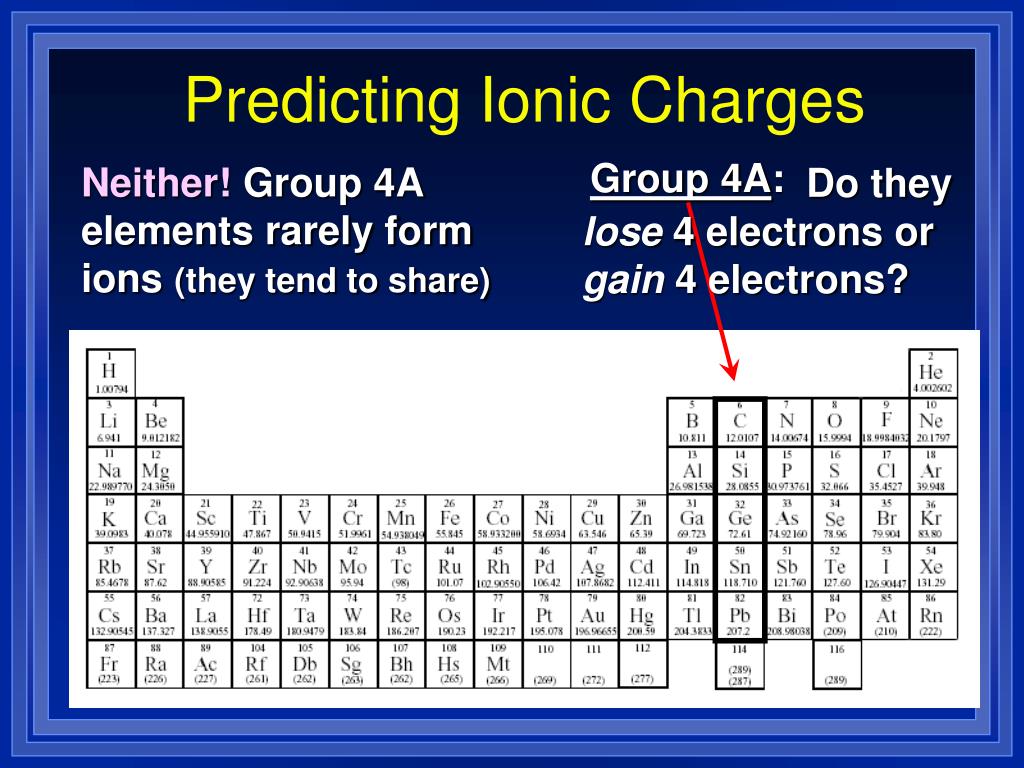
What Charge Do Ionic Compounds Have. When forming an ion, a zinc atom loses its two valence electrons, becoming a zn2+ ion. It depends on the charges of the components of the compound.
If the polyatomic chemical entity has a charge, it is no longer a compound, but is now a polyatomic ion. The compound is neutral overall, but consists of positively charged ions called cations and negatively charged ions called anions. The atoms in chemical compounds are held together by attractive electrostatic interactions known as chemical bonds.
The Charge On The Anion Is Balanced By The Charges On And Numbers Of The Cation.
The ions are held together in a regular spatial arrangement by. Of course, in solution, these species might ionize to give solvated ions. An ionic compound is never formed between two cations only or two anions only.
These Can Be Simple Ions Such As The Sodium (Na +) And Chloride (Cl −) In Sodium.
Is zinc an ionic compound? When the atom loses or gains one or more electrons, the electric charge is generated (and an ion is formed). The compound is neutral overall, but consists of positively charged ions called cations and negatively charged ions called anions.
If Any Compound Want To Remain As A Whole, Then Charge On Cation Must Be Equal To The Charge On Anion ,.
Ionic compounds and molecular compounds are. A proper ionic formula has a cation and an anion in it; If the polyatomic chemical entity has a charge, it is no longer a compound, but is now a polyatomic ion.
When Forming An Ion, A Zinc Atom Loses Its Two Valence Electrons, Becoming A Zn2+ Ion.
C a3p 2 c a 3 p 2, calcium phosphide (used as a rodenticide and in fireworks) kl k l, potassium iodide (an additive of table salt used to prevent goiter) li3n l i 3 n, lithium nitride (a reducing agent) m. Iron bromide does the same, with the positive charge from the iron canceling out the negative charge from the bromide. The atoms in chemical compounds are held together by attractive electrostatic interactions known as chemical bonds.
Magnesium Is In Group 2, Therefore Its Ion A Charge Of 2+.
Na have 1 +ve charge. Ionic compounds contain positively and negatively charged ions in a ratio that results in an overall charge of zero. Ionic compounds (at gcse) have an overall charge of zero so the positive and negative charges must be of equal size to cancel each other out.


Comments
Post a Comment